
The Invisible Workforce: How Mexico City’s Cleaners are Denied Basic Rights
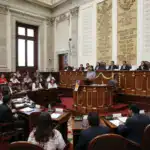
Mexico City, Mexico – More than 20,000 sanitation workers in Mexico City are trapped in a system of labor informality, systematically denied fundamental rights and social security. This alarming situation has been brought to light by a new legislative initiative presented in the local Congress, aiming to dignify the work of these essential public servants.
The initiative, championed by local Movimiento Ciudadano (MC) deputy Patricia Urriza, reveals how the Secretariat of Works and Services (Sobse) employs three distinct, and often exploitative, contracting schemes for the city’s cleaning personnel. Urriza’s proposal, presented on March 10, 2026, seeks to amend Article 10 of the Mexico City Political Constitution to ensure that all workers, regardless of their employment scheme, are guaranteed the labor benefits established by law.
The Three-Tiered System of Informality
Deputy Urriza, who has previously advocated for better conditions for sanitation workers, explained in an interview with Reporte Índigo that her investigation into their employment practices uncovered a deeply flawed system. “After presenting motions for the return of fluorescent uniforms for sanitation workers, many employees approached me with specific complaints about their contracting methods,” Urriza stated.
Her findings expose a stark contrast in employment conditions:
- The Unionized Workers: Approximately 14,000 individuals are formally employed through the union, representing the only group with recognized labor rights and benefits.
- The “Volunteers”: This “quite strange” scheme, as Urriza describes it, involves an estimated 10,000 workers who perform cleaning duties but survive solely on tips and whatever they can salvage from waste. They receive no formal salary, benefits, or social security.
- Social Program Beneficiaries: Around 3,000 workers are engaged through a social program called “Transforming the Capital, Public Services Close to the People 2026.” This program, despite explicitly aiming to provide urban services like street cleaning and repaving, deliberately avoids establishing an employment relationship with the Mexico City government. Beneficiaries are even required to sign a letter stating that no labor relationship exists, effectively denying them social security and other labor protections.
A System Designed to Deny Rights
The social program scheme is particularly egregious. Urriza highlighted that it is “designed to employ sanitation workers specifically to not give them social security.” While these workers have specific responsibilities and obligations, they are not recognized as employees, leaving them without set working hours, rest days, or any other labor rights at a time when discussions around reducing the workweek to 40 hours are gaining traction at the federal level.
“We have to denounce these inconsistencies, these violations,” Urriza emphasized. “This initiative is precisely to prohibit, regardless of the work regime, or contracting, or labor linkage, that authorities grant labor benefits, and it is very easy to prove in this sense that there is indeed a labor relationship as such, and to guarantee social security.”
The Call for Dignified Employment
The proposed reform to Article 10 of the Constitution of Mexico City explicitly states: “In all cases, regardless of the regime, type of contract, or form of labor linkage, the authorities will guarantee that the labor benefits established in current legislation are granted to ensure dignified employment for all workers.” This aims to eliminate the loopholes that allow the Sobse to circumvent formal employment obligations.
The initiative also seeks to ban voluntary work schemes and social programs that do not guarantee minimum labor benefits, ensuring that all individuals working for any authority or dependency of Mexico City have access to social security, necessary tools for their job, and a safe working environment.
Confronting Institutional Informality
This legislative push comes amidst broader discussions on labor rights, including the gradual reduction of the workweek to 40 hours at the federal level. The stark reality faced by Mexico City’s sanitation workers – with nearly half of them operating without basic labor protections – underscores a systemic issue of institutional informality.
The initiative, if passed, would represent a significant step towards ensuring that those who keep Mexico City clean and functional are afforded the dignity and rights they deserve, challenging a long-standing practice that has left thousands vulnerable and exploited.