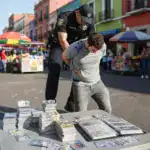
Mexico City, March 22, 2026 – The arrest of Ángel Esteban Aguilar, alias “Lobo Menor,” in Mexico City, a high-ranking operator of the Ecuadorian criminal organization “Los Lobos,” has been hailed by US Ambassador to Mexico, Ronald Johnson, as a strong message to international criminals. Johnson stated that the coordinated international effort behind this capture demonstrates that criminals “have nowhere to hide.”
International Cooperation Leads to Significant Arrest
Ambassador Johnson took to social media to highlight the significance of Aguilar’s arrest, emphasizing the crucial role of international collaboration in combating cartels, drug trafficking, and the violence perpetrated by criminal organizations. “The cooperation promoted by Donald Trump and President Claudia Sheinbaum Pardo is yielding concrete results and sends a clear message: criminals have nowhere to hide. Neither in Mexico, nor in the United States, nor internationally,” he wrote.
“Lobo Menor” is identified as a key figure within “Los Lobos,” responsible for overseeing the logistics and security of drug shipments. Furthermore, South American agencies and Interpol link him to sicariato (contract killing), extortion, and the assassination of Fernando Villavicencio, the former presidential candidate of Ecuador, who was murdered during his campaign in Quito in 2023.
Details of the Capture
The arrest took place in the Polanco neighborhood of the Miguel Hidalgo borough. The operation involved elements from the Mexican Navy (Semar), the Secretariat of Security and Citizen Protection (SSPC), the Citizen Security Secretariat (SSC), and the National Migration Institute (INM), working in collaboration with the Colombian Police.
The Rise of ‘Los Lobos’ and Their Alliance with CJNG
The US Department of Justice has identified “Los Lobos” as providing security services to the Jalisco New Generation Cartel (CJNG), supporting their efforts to control drug trafficking routes from Ecuador. The emergence of this criminal group in Ecuador’s criminal landscape dates back to 2020, following the assassination of Jorge Luis Zambrano, leader of “Los Choneros.”
In an interview with Infobae Mexico, Víctor Sánchez Valdés, a researcher at the Autonomous University of Coahuila, explained that Zambrano’s death led to an internal fracture within “Los Choneros,” a group that had maintained strong ties with the Sinaloa Cartel for over a decade. “Los Choneros had maintained an alliance with the Sinaloa Cartel for many years, already working for ten to fifteen years, but in 2020 there was a kind of great schism, and then this organization went into crisis after the death of its leader,” he explained.
From this crisis, three new organizations emerged: “Los Lobos,” “Los Chone Killers,” and “Los Tiguerones.” “The largest of these schisms was ‘Los Lobos,’ which began to dispute control with Los Choneros,” Sánchez Valdés specified. In this context of confrontation, the CJNG, in its quest to access the Ecuadorian cocaine market, established links not only with “Los Lobos” but also with the other two factions.
The agreements included a regular supply of weapons and supplies, as well as the systematic purchase of cocaine shipped from Ecuador’s main ports, Guayaquil and Manta, destined for Mexican coasts such as Colima, Lázaro Cárdenas, and occasionally, Salina Cruz in Oaxaca. “The Sinaloa (cartel) supplied weapons to Los Choneros and the Jalisco Cartel to Los Lobos. They provided them with weapons and supplies and systematically bought cocaine shipments that left Guayaquil and Manta, the two main ports of Ecuador. And in the case of the Jalisco New Generation Cartel, they received shipments in Colima and Lázaro Cárdenas above all, although also in other Pacific ports, such as Salina Cruz in Oaxaca,” the specialist noted.
This significant arrest underscores the ongoing efforts by international authorities to dismantle transnational criminal networks and highlights the effectiveness of collaborative law enforcement operations.