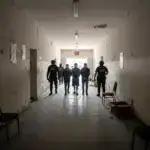
Ciudad Juarez is all too familiar with the problem of addiction. It is neither a new nor a fleeting phenomenon. For decades, this border city has lived with successive waves of consumption: heroin, cocaine, crack, methamphetamine, and more recently, crystal meth. Each has left its own trail of broken families, lost jobs, violence, and despair.
Spiritual Patrol: A Timely Intervention or a Contentious Approach?
This is why the possibility of the Spiritual Patrol establishing itself in the city one day has attracted attention. Although no formal procedures for its installation exist yet, the mere fact that the topic has entered public discussion reveals an evident reality: Juarez still needs more rehabilitation centers and more alternatives to rescue individuals trapped by drugs.
What is interesting about this case is who said it. Carlos Ortiz, the governor’s representative in Ciudad Juarez, considered the eventual arrival of the Spiritual Patrol positive and stated that it would be welcome if it decided to set up in the border city. The declaration carries political weight because it does not come from an activist or a religious leader, but from an official who has first-hand knowledge of the city’s social problems.
Ortiz acknowledged something many prefer to ignore: the need far exceeds existing capacity. Juarez has rehabilitation centers, public programs, and civil organizations working on the issue, but the magnitude of the problem remains enormous. When an authority admits that more options are needed, it is worth listening.
Faith and Recovery: A Double-Edged Sword?
The Spiritual Patrol became known in Tijuana for walking the streets where people trapped by addiction live and directing them to rehabilitation centers linked to the “Jireh” project. Their work combines community assistance, discipline, accompaniment, and Christian orientation. And it is precisely this last element that generates controversy.
For some sectors, any faith-inspired initiative immediately raises suspicions. It seems that the problem is not that someone helps an addict, but that they do so from a religious conviction. However, reality is often more complex than ideologies.
Anyone who has lived with an addicted person knows that the problem is rarely solely chemical. Behind it often appear family abandonment, violence, resentments, loneliness, lack of purpose, and loss of hope. The drug destroys the body, but it often takes root first in an already fractured life.
That is why recovery requires more than medication. Medical and psychological care are indispensable, but many people also need to rebuild bonds, discipline, community, and a sense of purpose. Faith, when authentic, can become a powerful tool to achieve this.
Of course, this does not mean granting blank checks. Every organization dedicated to rehabilitation must comply with the law, respect human rights, and submit to health supervision. No project, however noble it may seem, can justify abuse, humiliation, or illegal deprivation of liberty. Regulation exists for a reason and must apply equally to all.
Beyond Prejudice: Seeking Real Solutions for Juarez
The fundamental question is not whether the Spiritual Patrol is Christian. The question is whether it helps. Whether it complies with the law. Whether it recovers people. Whether it strengthens families. Because a city like Juarez needs less prejudice and more results.
For decades we have seen the human cost of addictions: lost children, destroyed marriages, entire families trapped in a spiral of suffering. Faced with such a reality, any serious effort to save lives deserves to be evaluated objectively and not with ideological labels.
Perhaps that is why Carlos Ortiz’s stance is so relevant. Instead of closing the door out of prejudice, he recognized a real need. And when a family has a child trapped by drugs, they stop asking who has the right ideology. They start asking who can help.
If the Spiritual Patrol arrives in Juarez and demonstrates that it can do so within the law, then the city will have gained something much needed: one more door for those seeking to return home. And that is the crux of the matter.
* The author’s comments are their own responsibility and do not necessarily reflect the views of the media.