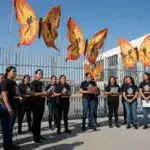

“They stole my right to be a mother”: Victims Expose Judicial Corruption in Mexico City
“They stole my right to be a mother to my children,” says Paola Domínguez Ramos, one of dozens of women affected by the Mexico City Judiciary and Public Prosecutor’s Office. These institutions, through legal trickery and alleged corruption, are accused of stripping mothers of parental authority and denying them the right to see and live with their children.
Under file 1051/2017 in Family Court 8, Paola has not seen her two children for six years. Her ex-husband, Omar Guadarrama Gutiérrez, suspiciously obtained custody, and in 2020, he used the COVID-19 pandemic as an excuse to prevent her from seeing the children. Despite the illegality of this action, no judicial authority has pursued justice or upheld the much-touted best interests of the children and their right to live with their mother. Instead, files have been lost, or requests for legal action by the mother have been deliberately delayed.
“It seems that the Mexico City courts are staffed by the lawyers of the aggressors and my counterpart. Many of us are suffering institutional violence, and no one seems to care, not even the president of the court, Rafael Guerra Álvarez, who does nothing despite the complaints,” Paola told La Jornada.
Paola is not alone. Dozens of women, including Marsha Marion Martínez Guajardo, Carla Pérez Abedrop, and Elena Lozanova, have reported judges for malpractice. These include Juan Miguel Morales Monter (now a magistrate), Araceli Cortés Eslava, Tania Cabezas San Román, Elisa Acevedo Solís, Sofía Regalado Espinosa, Magistrate Rebeca Florentina Pujol Rosas, and Magistrate Ricardo Oropeza Bueno, as well as the acting secretary Ana Lilia Hernández Baños. Complaints have also been lodged against the coordinating gender prosecutor, Gema Guadalupe Chávez Durán, and the prosecutor for crimes against girls, boys, and adolescents, Fabián García García.
Lawyers and Authorities in Collusion: The Case of Paola Domínguez Ramos
Paola’s case file spans four thousand pages and has passed through eight judges. She recounts that it all began when she filed for divorce and child support for her sons, Emiliano and Mateo, aged 11 and 17 respectively. At that time, her ex-husband allegedly told her: “I’m not going to give you anything, do what you can.” He reportedly made good on this threat, leaving her destitute and taking the children “by force.”
“At first, I didn’t know the terms or details of these types of processes. Like many of us, I had no idea. I trusted the lawyer I had, but in reality, she was deceiving me. She betrayed me because the judge decided to take away my custody for no reason. My ex’s lawyer was a close friend of the judge’s right-hand man, and my lawyer studied with my ex-spouse’s defender. So I lost custody because she sold out; that’s how they managed to make my process completely flawed.”
She adds that she was eventually made to sign an agreement that failed to establish clear rules for visitation, allowing her ex-husband to repeatedly prevent her from seeing the children. “They didn’t do things well; they didn’t establish the days for visitation, holidays, birthdays, or Christmas.” Paola claims she was never told why her custody was revoked. “I didn’t know I could file an appeal because my lawyer told me I had to show good faith in the face of everything the judge was doing.”
The signed agreement did not specify the days she would spend with her children. “When I complained to the secretary, he told me: ‘as if you didn’t know, madam: it’s every 15 days, and that’s how it has to be,’ and my ex-husband argued: ‘if it’s not on paper, I’m not going to allow my children to visit their mother.’ Six years later, no one has forced him or removed his parental authority for constantly violating the law.”
She adds: “I requested a modification of the agreement a thousand times because it wasn’t fair that they took my children away and didn’t allow me to live with them properly. They never made the change. They said I only had two visits a week, Mondays and Wednesdays, to pick them up from school and had to drop them off at 7 p.m., bathed and fed, at their father’s house. In reality, I spent half an hour with my children because they had their activities, but since March 19, 2020, their father has not allowed anything else, and I haven’t seen them since.”
Marsha Marion Martínez Guajardo: A Case of Corruption and Neglect
The case of 45-year-old fitness trainer Marsha Marion Martínez Guajardo, a victim of vicarious violence, further highlights the corruption and neglect within the judiciary in defending the best interests of minors and protecting women from their aggressors. Marsha Marion resided in California, USA, for several years. Upon moving to Mexico, she filed for divorce in December 2018. Her ex-husband, Rafael Gerardo Olvera Serrano, is reportedly flagged by US authorities for alleged ties to drug trafficking.
Despite three convictions for domestic violence against him, judicial authorities stripped Marsha of her parental rights to her children, a six-year-old girl and a four-year-old boy, on November 7, 2019.
“My ex-husband fabricated a file with 23 child abuse accusations against my children. Within three weeks, an unconstitutional hearing was held where protective measures were imposed on me to stay away from my children, and then he requested a change of custody.” Her aggressor’s greatest obsession, she asserts, was “to kill his ex-wife. He became very violent and threatened me. The abuse escalated beyond imagination. There are three convictions against him for domestic violence to prove the type of aggressor he is, and despite all that, they took my children away from me.”
After three appeals, she adds, her children were returned to her last March, “after forcing them to live with their aggressor, having them with emergency third parties, and living with threats from their aggressor. The judicial system is disgusting. In court, they were very much in favor of my ex-partner, accepting that I was an aggressor.”
She recalls that her children were returned to her only after Judge Morales Monter was replaced, and even though her ex-partner had protective measures to prevent contact with the children, “he managed to get the judge to investigate me and a magistrate to say that I don’t have the optimal faculties to raise my children, inventing psychiatric disorders that the psychiatry institute itself disproved.” This was the strategy to keep her away from her children, and in the same court, they tried to force her to reconcile with her ex-spouse. “It was their way of breaking me to try reconciliation. They told me I was conflictive and that the violence I experienced ‘wasn’t that bad.’ I told them: ‘you have me next to the man who rapes me, and you want me to hold his hand?’ ‘What is happening?’ I asked Magistrate Rebeca Florentina Pujol Rosas.”
The legal battle continues to this day. “I won’t rest until I see you dead,” Olvera Serrano repeatedly told her. “My life remains in danger, but the authorities don’t care about that. He belongs to organized crime; the DEA reports are there.” Marsha Marion remembers that under the management of former prosecutor Ricardo Guzmán Cruz, a file in which she was denounced by her ex-husband was hidden from her for two months. “It was with pressure that they finally let me see it. My daughter claimed that her father told her to say that I hit her brother, but that wasn’t true. With that stupid complaint, they took my children away for six years.”
Paola Domínguez Ramos, in turn, laments that so many women are having their children taken away with trickery and due to the corruption prevalent in the Mexico City Judiciary. “The judge saw the parental alienation my children are experiencing and didn’t have the guts to take the children away from their abusive father.” She asserts that her son Mateo is now “totally alienated” by his father. “I feel like I’ve lost him because of the government and his father. It’s as if no one reads my file. My children are kidnapped, and the Judiciary does nothing. So much indifference and lack of interest is unacceptable. We are talking about minors; not about me, who has suffered severe psychological damage supported by psychologists. They don’t have the guts to remove my children’s aggressor.”
No Child Support: The Case of Carla Pérez Abedrop
The case of Carla Pérez Abedrop, a breast cancer survivor, also exposes the corruption and neglect of the Judiciary. She was married to Spaniard Álvaro Moya Corral for three years, and when she asked for a divorce, he warned her: “I’m going to take everything from you, including the children.” She recounts suffering psychological, economic, and vicarious violence; like other women, her ex-husband inundated her with lawsuits. Due to her illness, she decided to change her residence and moved to Mexico City, where she handled some of the judicial processes.
“I stayed with my children for a year and took the opportunity to file for divorce in 2023. At that moment, he came at me like a demon; then he cut off financial support and refused to pay alimony.” Carla remembers experiencing institutional violence because both Public Ministry agents and judges “sold out; I lived a situation 20 thousand times worse than before. Through the corruption of the authorities, he took my house, my truck; he took everything from us, and the worst thing is that he took my children away for 13 months.”
Unanswered Questions and Calls for Accountability
This investigation reveals a disturbing pattern of alleged corruption and systemic failures within the Mexico City Judiciary and Public Prosecutor’s Office. The testimonies of these mothers paint a grim picture of a system that, instead of protecting the vulnerable, appears to facilitate abuse and deny fundamental rights.
Key questions remain unanswered:
- Why are so many cases of alleged vicarious violence seemingly ignored or mishandled by judicial authorities?
- What accountability mechanisms are in place to prevent judges and prosecutors from engaging in corrupt practices?
- How can the “best interests of the child” be genuinely upheld when mothers are systematically denied access to their children through questionable legal means?
- What steps will the Mexico City Judiciary and Public Prosecutor’s Office take to address these serious allegations and restore public trust?
The victims, like Paola, Marsha, and Carla, continue their fight for justice, not only for themselves but for their children, who are caught in a legal and emotional quagmire. Their stories underscore an urgent need for transparency, accountability, and a thorough overhaul of the judicial processes concerning family law in Mexico City.
Source: https://www.jornada.com.mx/noticia/2026/05/03/politica/victimas-de-violencia-vicaria-acusan-a-fiscalia-y-jueces-de-la-cdmx-de-proteger-a-agresores