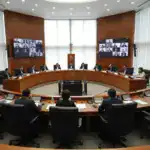
Mexico City, April 27, 2026 – In anticipation of the 2026 FIFA World Cup, the Mexico City Congress held a crucial working session this Monday with the Secretary of Comprehensive Risk Management and Civil Protection (SGIRPC) and the Political Coordination Board (JUCOPO). The meeting, which took place in the “Benita Galeana” Hall of the Donceles Legislative Precinct, focused on analyzing the safety protocols and conditions for attendees at the various mass events planned for the global sporting event, set to kick off on June 11 at the Banorte Stadium.
Legislators Address Key Safety Concerns
Legislators from various political parties represented in the capital’s Congress engaged in discussions with Myriam Urzúa Venegas, the Head of SGIRPC, regarding comprehensive risk management and civil protection in light of the expected arrival of millions of national and international visitors. Deputy Lizzette Salgado Viramontes, President of the Comprehensive Risk Management and Civil Protection Commission, initiated the session by raising questions concerning the authorities’ response capabilities during contingencies in high-density areas, especially considering Mexico City’s seismic context.
“What is the installed capacity in terms of response times, number of personnel, equipment, and available infrastructure?” inquired Deputy Salgado Viramontes. She further emphasized the necessity of informative campaigns targeting tourists, who may be unfamiliar with earthquake protocols.
Deputy Andrés Atayde Rubiolo, President of JUCOPO, voiced concerns about the existence, validation, and effectiveness of action protocols in risk scenarios. “Does the city have specific protocols for the nature of these mass events, and have they been tested through drills?” he asked. He also highlighted the importance of inter-institutional coordination, stressing that beyond daily operations, clear mechanisms are essential for critical situations. “Who will assume operational command in an emergency, and will there be a willingness not to politicize moments of risk?” he underscored.
Mexico City Prepares for Millions of Visitors
Deputy Atayde Rubiolo further noted that Mexico City will host five matches and numerous ancillary events, including public screenings of games in locations such as the Zócalo and main esplanades of the boroughs. These events significantly increase the challenges related to security and organization. “We expect more than five million people, making it fundamental to have a broad dissemination campaign on safety measures, especially for visitors,” he stated.
In response, the Secretary of Comprehensive Risk Management and Civil Protection, Myriam Urzúa, confirmed that her department has been working for over a year to mitigate risks during the World Cup. “Our objective is to implement actions that guarantee the safety of attendees through the strengthening of infrastructure, specialized protocols, mass training, and compliance with international standards,” she explained.
Secretary Urzúa detailed that the strategy is structured around five pillars: Alert City, Prepared City, Informed City, Resilient City, and Host City. The first pillar involves continuous monitoring of meteorological phenomena and the constant issuance of early warnings through various channels, including the C5 system, radio, and television.
Myriam Urzúa also confirmed the existence of specific protocols for various scenarios, including earthquakes, floods, major emergencies, and chemical, biological, radiological, nuclear, and explosive risks. At the close of the meeting, Deputy Lizzette Salgado reiterated her interest in the progress made in three key areas: the regulatory framework, inter-institutional operations, and the availability of human and material resources. These elements are crucial to ensuring the capital is prepared for one of the most significant global events.
Deputies Ernesto Villarreal Cantú of the Labor Party and Ángel Augusto Tamariz Sánchez of MORENA also attended the event.
Source: Mexico City Congress