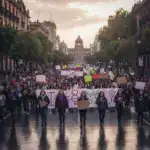
The aroma of stale coffee and the distant hum of city traffic are the only constants for Angélica Gómez and her neighbors. For 365 days, the pavement outside República de Cuba 11 in Mexico City’s Historic Center has been their home, a stark testament to a life uprooted. Evicted without warning a year ago, these residents, many of them elderly, have transformed the street into a makeshift camp, a defiant symbol of their struggle against displacement.
A Year of Uncertainty and Hope
“We have spent 365 days living in uncertainty, fear, anxiety, helplessness, and a profound sense of injustice,” recounted Angélica Gómez during a press conference. Her words echo the sentiments of the 19 families and eight businesses that were abruptly removed from their building on August 27, 2025. This Thursday, they reiterated their demand for the expropriation of the property, a glimmer of hope in their prolonged ordeal.
The administrative process for expropriation is in the hands of the Housing Institute (Invi). Mexico City’s mayor, Clara Brugada, had expressed optimism on August 5, stating she expected the case to be resolved by the end of the month. However, the residents remain in limbo, their wait extending beyond the mayor’s hopeful timeline.
The Legal Labyrinth and Unanswered Calls
Arturo Aparicio, the residents’ lawyer, explained that the expropriation process is indeed underway, with two public utility notices already published. Yet, the issuance of the decree has been delayed, as have several scheduled meetings with Mayor Brugada. “We are concerned that the government is holding back on resolving the case quickly,” Aparicio stated, despite assurances from authorities that the procedure is “progressing steadily.” The residents, he added, are eagerly awaiting a “forceful solution.”
The dawn of August 27, 2025, brought with it an abrupt end to decades of stability for many. Located just a few blocks from the Zócalo, the heart of Mexico City, the building at República de Cuba 11 was home to a vibrant community. Now, it stands as a silent monument to their displacement, while its former inhabitants brave the elements in tents, surrounded by their salvaged belongings.
Life on the Pavement: A Constant Battle
Life in the camp is a daily struggle. Exposed to rain, cold, lack of basic services, and insecurity, the residents have faced numerous challenges. Over the past year, heavy rains have repeatedly damaged their protective tarps. They have also had to contend with individuals who, they allege, attempted to enter the building, further highlighting their precarious situation.
“After 365 days, we are still here, we are still resisting,” Gómez affirmed, her voice tinged with both weariness and resolve. The human cost of their displacement is tragically evident. Three tenants have passed away in the last year, including Doña Lupita, the building’s oldest resident, who was over 90. “Unfortunately, she could not spend her last days in the house where she lived for almost her entire life,” Gómez lamented, her words painting a poignant picture of loss.
A Symbolic Act of Defiance
To mark their year of unwavering resistance, the residents held a symbolic burning ceremony at the corner of Eje Central and República de Cuba. This act mirrored the protest they staged in the same spot a year ago, immediately after their forceful eviction. It was a powerful reminder of their enduring fight and their refusal to be silenced.
This case has become a poignant symbol of the escalating conflict over housing, evictions, and gentrification in Mexico City’s Historic Center. The issue has intensified in the months leading up to the 2026 World Cup, putting immense pressure on vulnerable communities. In May, even the city government defended an anti-gentrification agenda at UN-Habitat, acknowledging a growing social unrest fueled by evictions and displacement.
“We don’t know if this will be a success story, but it has created the illusion that progress can be made from dispossession, from eviction, to a housing agenda,” Aparicio concluded. For the residents of República de Cuba 11, this illusion is a lifeline, a reason to continue their vigil on the streets of a city that once was, and they hope will be again, their home.
Source: https://es-us.noticias.yahoo.com/vecinos-acampan-a%C3%B1o-frente-edificio-022405044.html